Weight loss injection: what retatrutide, Mounjaro and Wegovy did in trials
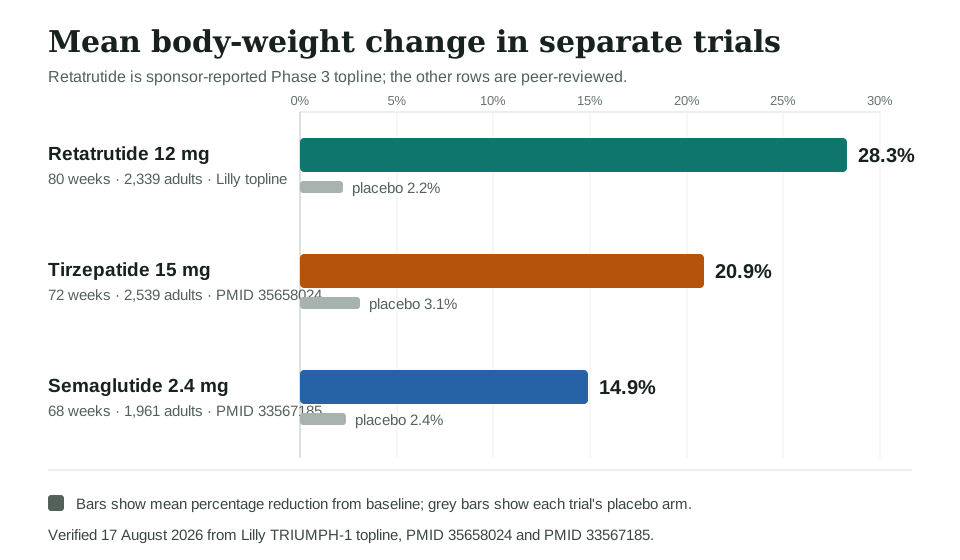
In randomised trials, each weight loss injection below led to a mean loss of more than 10% of body weight. Lilly's TRIUMPH-1 topline gives the retatrutide 12 mg mean weight change as -28.3% over 80 weeks versus -2.2% with placebo (efficacy estimand; checked 17 August 2026).
Tirzepatide 15 mg gave a mean weight change of -20.9% at 72 weeks versus -3.1% with placebo (PMID 35658024; checked 17 August 2026). The trial had 2,539 adults (PMID 35658024; checked 17 August 2026). Eli Lilly funded the trial (PMID 35658024; checked 17 August 2026).
Semaglutide 2.4 mg gave a mean weight change of -14.9% at 68 weeks versus -2.4% with placebo (PMID 33567185; checked 17 August 2026). The trial had 1,961 adults (PMID 33567185; checked 17 August 2026). Novo Nordisk funded the trial (PMID 33567185; checked 17 August 2026).
TRIUMPH-1 assigned 2,339 adults to groups at random (NCT05929066). They had obesity, or overweight plus at least one weight-related health problem. Eli Lilly paid for and ran the trial. The firm says it will publish the full results in peer-reviewed journals.
For the treatment-regimen estimand, the 12 mg mean weight change was -25.0% at 80 weeks, versus -3.9% with placebo.
These were separate trials. They used different groups and ran for different lengths of time. They were not head-to-head tests.
Go directly to:
- Retatrutide trial detail
- Counterfeit GLP-1 case reports
- What independent tests found in vials
- When symptoms need prompt help
What are peptides for weight loss?
These drugs are made from peptides. Some are approved medicines. Others are still being studied. They act on hormone receptors that help control hunger, blood sugar and weight.
Semaglutide acts on the GLP-1 receptor. It is the drug in Wegovy, which the EU has approved for weight loss.
Tirzepatide acts on GIP and GLP-1 receptors. It is the drug in Mounjaro, an EU-approved medicine.
Retatrutide acts on GIP, GLP-1 and glucagon receptors. It is still being studied.
The drugs are related. Their trial results must be kept apart. Their approval status is a separate question. So is what tests found in products (PMID 37366315; PMID 35658024; EMA product records; checked 17 August 2026).
More on the chemistry is in What is a peptide?.
How much weight did people lose?
| Trial | Mean change | Placebo |
|---|---|---|
| Retatrutide 12 mg · TRIUMPH-1 Phase 3 topline · 2,339 adults · 80 weeks | -28.3% | -2.2% |
| Tirzepatide 15 mg · SURMOUNT-1 · 2,539 adults · 72 weeks | -20.9% | -3.1% |
| Semaglutide 2.4 mg · STEP 1 · 1,961 adults · 68 weeks | -14.9% | -2.4% |
For tirzepatide at 15 mg, the estimate had a 95% confidence interval of -21.8% to -19.9%. The gap between semaglutide and placebo was -12.4 percentage points, with a 95% confidence interval of -13.4 to -11.5.
Lilly TRIUMPH-1 topline, 21 May 2026 · PMID 35658024 · PMID 33567185 · checked 17 August 2026.
How many people reached each weight-loss target?
Lilly reported that at least 25% weight loss was reached by 62.5% of the 12 mg group and 2.2% of the placebo group. At least 30% was reached by 45.3% of the 12 mg group and 0.5% of the placebo group. At least 35% was reached by 27.2% of the 12 mg group and 0.3% of the placebo group (Lilly TRIUMPH-1 topline; checked 17 August 2026).
In SURMOUNT-1, at least 5% weight loss was reached by 85%, 89%, and 91% of the 5 mg, 10 mg, and 15 mg tirzepatide groups. In the placebo group, 35% lost at least 5% of their weight.
At least 20% weight loss was reached by 50% of the 10 mg group and 57% of the 15 mg group. In the placebo group, 3% reached at least 20% weight loss.
In STEP 1, at least 5% weight loss was reached by 86.4% with semaglutide and 31.5% with placebo. At least 10% weight loss was reached by 69.1% with semaglutide and 12.0% with placebo. At least 15% body-weight reduction was reached by 50.5% with semaglutide and 4.9% with placebo (PMID 35658024; PMID 33567185; checked 17 August 2026).
Retatrutide dose arms in the phase 2 obesity trial
At 48 weeks, the 1 mg group had a least-squares mean weight change of -8.7%. At that point, the 4 mg group had a least-squares mean weight change of -17.1%. The 8 mg group had a least-squares mean weight change of -22.8% at 48 weeks. The 12 mg group had a least-squares mean weight change of -24.2% at 48 weeks.
Each person in the 8 mg and 12 mg groups reached at least 5% weight loss. In the 12 mg group, 83% reached at least 15%, compared with 2% on placebo (PMID 37366315; NCT04881760; funded by Eli Lilly; checked 17 August 2026).
A separate phase 3 retatrutide trial in type 2 diabetes
TRANSCEND-T2D-1 was a 40-week trial in 537 adults with type 2 diabetes. The 12 mg group had a mean weight change of -15.3%, versus -2.6% on placebo.
Adverse events led 2% to 5% of people on the drug to stop it. The rate was 0% on placebo. This trial found no severe low blood sugar among its 537 adults (PMID 42250575; funded by Eli Lilly; checked 17 August 2026). Two people in the 4 mg group died. The paper says neither death was due to the study drug.
What side effects did the trials record?
Retatrutide side effects in TRIUMPH-1
At 12 mg, nausea occurred in 42.4%, compared with 14.8% on placebo. Diarrhoea occurred in 32.0%, compared with 13.5%. Constipation occurred in 26.1%, compared with 10.9%. Vomiting occurred in 25.3%, compared with 4.8%.
Dysesthesia, an altered sense of touch, occurred in 12.5% of the 12 mg group and 0.9% of the placebo group. Urinary tract infections occurred in 8.4% and 5.3%.
Adverse events led 11.3% of the 12 mg group to stop the drug. The rate was 4.9% on placebo.
The ADA slides report new or worsened health events in 87.0% to 89.2% of people on retatrutide. The rate was 80.7% on placebo. Serious events were reported in 7.7% to 10.5% of people on the drug. The rate was 5.5% on placebo.
TRIUMPH-1 ADA presentation · funded by Eli Lilly · checked 17 August 2026.
Retatrutide side effects
Stomach and gut effects were the most common side effects in the phase 2 trial. The abstract says their rate depended on the dose. Most were mild to moderate. The authors say a lower starting amount partly reduced these effects.
The rise in heart rate depended on the dose. It peaked at week 24 and then fell (PMID 37366315; funded by Eli Lilly; checked 17 August 2026).
Tirzepatide and Mounjaro side effects
Stomach and gut effects were the most common side effects in SURMOUNT-1. The abstract says most were mild to moderate. They occurred mainly while the trial dose was being raised.
Adverse events led 4.3%, 7.1% and 6.2% of the 5 mg, 10 mg and 15 mg groups to stop treatment. The rate for placebo was 2.6% (PMID 35658024; funded by Eli Lilly; checked 17 August 2026).
Semaglutide side effects in Wegovy trials
Nausea and diarrhoea were the most common side effects in STEP 1. The paper says these were mostly short-lived and mild to moderate. Stomach and gut effects led 4.5% of people on the drug to stop it. The rate was 0.8% on placebo.
An analysis that pooled STEP 1 to STEP 3 gave median lengths of 8 days for nausea, 3 days for diarrhoea, and 2 days for vomiting. The median length of constipation was 47 days with semaglutide and 35 days with placebo (PMID 34514682; the STEP trials were funded by Novo Nordisk; checked 17 August 2026).
Is retatrutide approved in Europe?
No agency has approved a medicine with retatrutide for public use. Eli Lilly makes the drug and pays for the trials above. The firm says the drug is still being studied (Eli Lilly's status page; checked 17 August 2026).
Retatrutide was absent from the EMA centralised medicines dataset on 15 August 2026. It was absent from Spain's CIMA national register on 16 August 2026.
Mounjaro is an EU-approved prescription drug. It contains tirzepatide. Its approved uses include weight loss in adults who meet the stated BMI and health criteria (EMA Mounjaro record; status checked 17 August 2026).
Wegovy is an EU-approved prescription drug. It contains semaglutide. Its approved uses include weight loss in adults who meet the stated BMI and health criteria (EMA Wegovy record; status checked 17 August 2026).
Ozempic also contains semaglutide. The EU has approved it for type 2 diabetes, not weight loss (EMA Ozempic record; status checked 17 August 2026).
What do people taking them say themselves?
These are self-reports. The people chose to post in public forums. None of these three posts discloses a sponsor or payment. None includes a lab test of the named drug or amount. Each quote links to the full thread.
Tirzepatide: the change in food noise
HoneydewGullible3539, two weeks after starting tirzepatide, in 2 weeks in and I'm genuinely blown away (thread text verified 17 August 2026):
Ok so I started tirzepatide two weeks ago. Down 3.5kg which cool, but honestly that's not even the main thing.
The food noise? Gone. Like actually gone.
I don't think people who haven't dealt with this get how big that is. I've spent 20+ years thinking about food nonstop. What's my next meal. Should I eat this. Why did I eat that. The guilt spiral. The "ok Monday I'm starting fresh" thing every single week. It's exhausting.
[...]
But now? I had lunch today and just... forgot about food for like 5 hours. That literally never happens to me. My brain is so quiet. I'm actually getting stuff done at work. Not constantly fighting myself.
Semaglutide: a first month on Wegovy
Pink_Tulip2828, who identified herself as 51 and female, in 1 month in - my experience so far (thread text verified 17 August 2026):
I officially finished my first month on Wegovy injections .25. I thought since most questions on here are around experiences, I'd post mine. Down just over 10 pounds which I am thrilled about since I wasn't expecting it.
[...]
After injection (maybe 1-2 days) slight nausea and/or headache in AM. Goes away once I drink water/coffee.
[...]
Experienced ZERO vomit, severe nausea, sulphur burps, constipation.
[...]
Mentally I feel positive. I am keeping a positive outlook and really wanted to have no expectations for the first few months to get acclimated. I do feel the "food noise" around snacking come back toward the end of my week before next injection.
Retatrutide: weight loss with appetite and gastrointestinal effects
PositionVast9155, who identified herself as 31 and female, in Can't eat? (thread text verified 17 August 2026):
So I’m going on my third week using Reta 2mg and I’m down just over 6lbs but I’ve had some wild side effects. The first week I was fine, appetite was suppressed but I could still eat, had some gas/sulphur burps after I ate eggs one night and that never went away. Week 2 I can barely look at food, the thought or idea of it is so unappealing and sometimes makes me sick to think about it. I can hardly take more than a few bites of something before I get nauseous.
I also have crazy diarrhea (tmi I know) and gas/sulphur burps and I can feel a lot of gurgling in my abdomen/intestines?.
What did independent tests and safety reports find?
Trials use drugs with known contents and strengths. What is in a vial bought online is a separate question.
The 6,487-report peptide-testing dataset
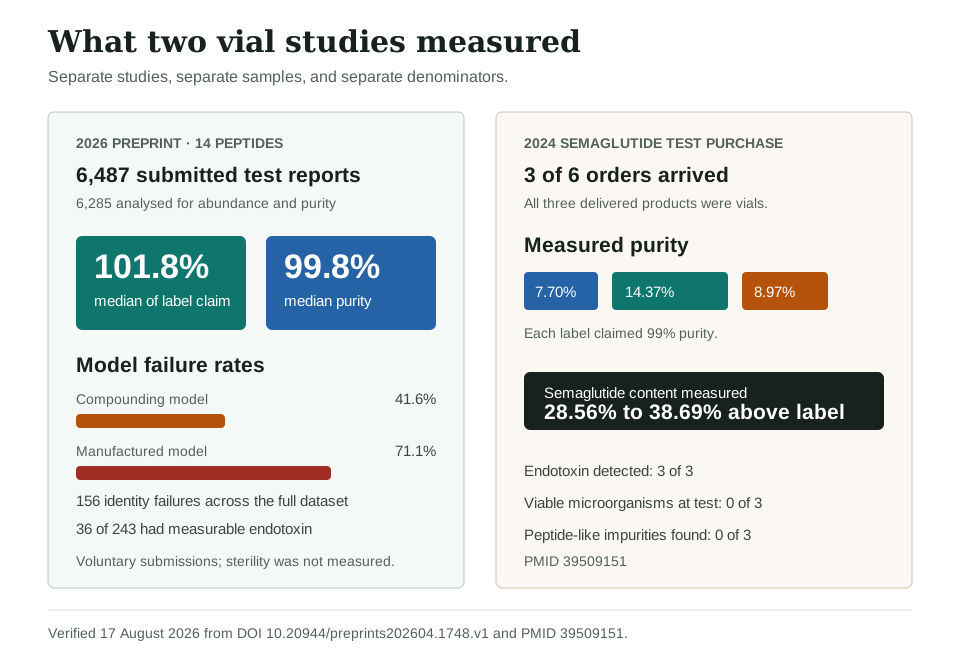
A 2026 preprint screened 6,487 reports sent in by choice. These covered fourteen peptides. The analysis of amount and purity used 6,285 reports. These came from 203 firms that make peptides.
In the 6,285 reports, the median amount was 101.8% of label claim. In that same group, median purity was 99.8%.
The authors used two models to judge the reports. In their compounding-standards model, 41.6% failed at least one test of identity, amount or purity. In their manufactured-standards model, 71.1% failed at least one test.
Across all fourteen peptides, 156 reports failed to match the named peptide. In 59 reports labelled retatrutide, no retatrutide was found.
Only 243 reports included tests for endotoxin. Of these, 36, or 15%, had low but measurable levels.
The authors say the samples were not random. They do not represent the whole grey market. The tests did not check sterility, leftover solvents, particles, stability or structural integrity. For that reason, the authors call their failure rates a lower bound.
The preprint says it had no outside funding. The authors say they have no conflict of interest (DOI 10.20944/preprints202604.1748.v1; checked against the primary PDF on 17 August 2026).
Three semaglutide vials bought from online sellers
A 2024 study placed six orders with online sellers. Three semaglutide vials arrived. Each had 28.56% to 38.69% more semaglutide than its label claimed.
Measured purity was 7.70%, 14.37%, and 8.97%, against 99% claimed on each product label. Liquid chromatography and mass spectrometry found no peptide-like impurities in the three delivered vials.
Tests found no living microbes in the three vials at that time. They found endotoxin in all three.
The Hungarian Scientific Research Fund paid for this study (PMID 39509151; checked 17 August 2026).
A JAMA Network Open report describes the same six orders and the same three delivered vials as the study above. It reports the same set of tests, not a new set (PMID 39093567; checked 17 August 2026).
Products sold as semaglutide that contained insulin
An Italian report describes a 31-year-old woman admitted to hospital in a coma from low blood sugar (PMID 41125326). Tests found insulin instead of semaglutide in the vial she had used (PMID 41125326; checked 5 September 2026).
Two Dutch patients were admitted to hospital in comas with severe low blood sugar. Both had injected products bought as semaglutide (PMID 42390457). The authors say synthetic insulin caused these effects (PMID 42390457; checked 5 September 2026).
234 European spontaneous reports
A EudraVigilance study found 234 case safety reports linked to possible fake semaglutide. It covered 1 January 2018 to 31 December 2025.
Vomiting, nausea and low blood sugar were the most common suspected drug reactions. 89.3% of the suspected reactions were serious. 73.5% of the reports were about women.
These 234 reports do not give a rate among users. The paper says no one knows how many people used the possible fakes. Without that number, it cannot work out a rate or other measure of risk.
Some reports may involve suspected fakes, not proven ones. Other uses of fake products may have gone unseen or unreported (PMID 42137313; checked 17 August 2026).
Common questions
Have retatrutide and Mounjaro been compared head-to-head?
No head-to-head trial of these two drugs was found in PubMed on 17 August 2026. A Bayesian network meta-analysis pooled 19 randomised trials with 29,506 adults. It compared them indirectly (PMID 40685589; checked 17 August 2026).
How long does retatrutide take to work?
TRIUMPH-1 gives a week-80 group mean, not an onset time (Lilly topline). Phase 2 least-squares means at week 24 were -17.5% (12 mg) and -17.3% (8 mg). At week 48, they were -24.2% and -22.8%. These give no individual onset time (PMID 37366315; checked 17 August 2026).
How long do semaglutide side effects last?
In the pooled STEP analysis, the estimated median length of nausea was 8 days. The estimated median length of diarrhoea was 3 days. The estimated median length of vomiting was 2 days. The median length of constipation was 47 days with semaglutide and 35 days with placebo (PMID 34514682; checked 17 August 2026).
Are Ozempic and Wegovy the same medicine?
Both EU-approved drugs contain semaglutide. Their approved uses differ. Wegovy is approved for weight loss in the groups named by EMA. Ozempic is approved for adults whose type 2 diabetes is not well controlled (checked 17 August 2026).
Does a vial label show that it matches the trials?
A vial label states what the seller or maker says is inside. The tests above found medians close to the label claims. They also found vials that did not contain the named drug. Trials show what the tested drug did. They do not show what is in a vial bought elsewhere (checked 17 August 2026).
Follow the evidence further
Questions shared across injectable peptides are grouped in the risk overview.