BPC-157/TB500 and other peptides used for training recovery
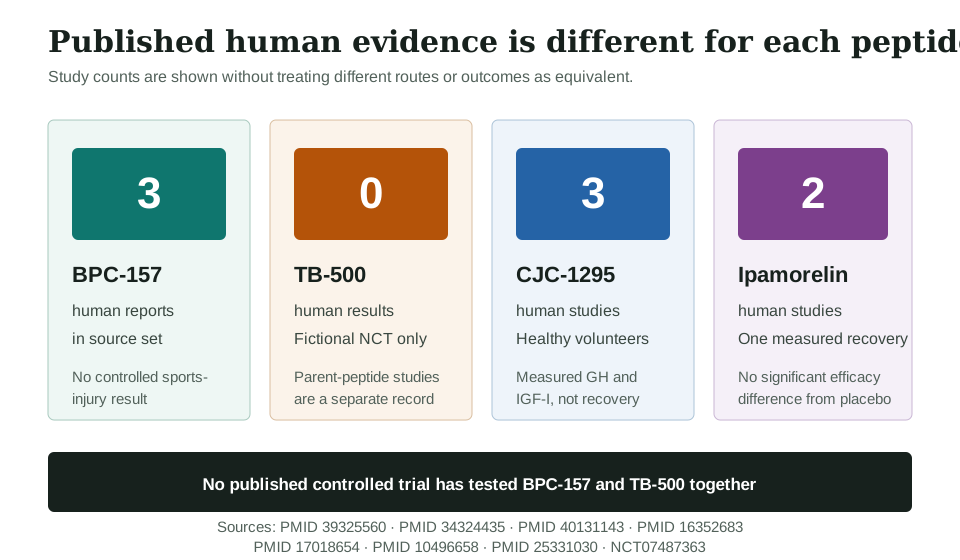
BPC-157/TB500 has not been tested together in a published controlled human trial. The BPC-157 source set has three published human reports: PMID 39325560, PMID 34324435 and PMID 40131143 (checked 2026-08-29). In PMID 39325560, 10 of 12 women said their bladder-pain symptoms had fully gone (checked 2026-08-29). In PMID 34324435, 11 of 12 people given BPC-157 alone reported less knee pain (checked 2026-08-29). In PMID 40131143, two people had no relevant change in the tested safety markers and reported no side effects (checked 2026-08-29). TB-500 has no published human result (checked 2026-08-21).
CJC-1295 and ipamorelin have separate human studies of hormone release. Those studies did not measure muscle gain, tendon healing or training recovery. AOD-9604 has human safety data, but its published efficacy result concerns nerve pain.
The answers below separate each molecule, each route and each outcome.
Go directly to:
- The complete BPC-157 evidence record
- Why TB-500 is not thymosin beta-4
- The CJC-1295 human studies
- The ipamorelin human studies
Five compounds, five different evidence records
| Compound | Direct answer | Full page |
|---|---|---|
| BPC-157 | Three human reports in the source set. They include bladder-pain, knee-pain and intravenous safety reports. No controlled human study read here tested a sports injury. | BPC-157 |
| TB-500 | No published human result. The exact TB-500 search at ClinicalTrials.gov returned only NCT07487363. Its summary identifies the study as a fictional example. The entry does not evidence an ongoing study (checked 21 Aug 2026). | TB-500 |
| CJC-1295 | Three published human studies. They measured growth hormone and IGF-I in healthy volunteers. | CJC-1295 |
| Ipamorelin | Two published human studies exist. A 320-person completed trial has not reported. | Ipamorelin |
| AOD-9604 | At least six randomised human trials are summarised in a safety paper. Three more trials are registered as LAT8881. | AOD-9604 |
AOD-9604: what did the human trials find?
A paper sums up six randomised, double-blind AOD-9604 trials with placebo controls. It reports no related withdrawal. It reports no related serious adverse event. It also reports no anti-AOD-9604 antibodies. The paper found no harmful effect on carbohydrate metabolism (DOI 10.4021/jem157w; checked 16 Aug 2026).
The paper is a safety summary. It does not give the six trial sizes. It does not give their identifiers. It gives no efficacy result. The source record does not contain a funding statement.
Three more trials are listed under the compound's other name, LAT8881: NCT03865953, NCT04153409 and NCT05298306. All were complete when checked on 16 Aug 2026.
The trial with posted results involved 53 people with nerve pain. It missed its main endpoint at p = 0.67. Neither arm had a serious adverse event. Lateral Pharma sponsored the trial (NCT03865953; checked 16 Aug 2026).
That trial used oral capsules. It measured nerve pain. It did not test training recovery or an injected product.
BPC-157 and TB500: what do the human studies show?
No published study has tested BPC-157 and TB-500 together in people. The evidence must therefore be read compound by compound.
BPC-157: three published human reports in the source set
A report involved 12 women with interstitial cystitis. Each woman received one treatment. Ten said their symptoms had fully gone. The other two rated their success at 80%. The authors reported no side effects (PMID 39325560; checked 16 Aug 2026).
The study had no control group. The outcome was a self-reported questionnaire. A clinician injected the compound around bladder inflammation during cystoscopy. This was not a study of a tendon, muscle or subcutaneous self-injection.
The available abstract gives no funding statement. The product came from a 503A compounding pharmacy. Those are distinct facts about funding and supply.
The second report involved two healthy adults. They received IV BPC-157. Both had used IV BPC-157 before the study. The team found no change in the tested heart, liver, kidney, thyroid or glucose markers. They also found no side effects (PMID 40131143; checked 14 Aug 2026).
That report measured safety over two days. It did not measure recovery or healing. It had no control group. Its available abstract gives no funding statement.
What the musculoskeletal review found
A 2025 systematic review screened 544 records. It kept 36 studies. Thirty-five were preclinical. One was clinical (PMID 40756949; checked 16 Aug 2026).
The clinical report was a review of past knee-pain cases. Seven of 12 patients said relief lasted more than six months. Another peer-reviewed review found no control group. It also found that the report relied on patient recall. The report used no validated outcome scale.
The systematic review reported positive results in preclinical muscle, tendon, ligament and bone models. It also found no clinical safety dataset. The positive animal findings and the human evidence gap are both part of its result.
A randomised Phase 2 trial now plans to test BPC-157 for MRI-confirmed hamstring strain. NCT07437547 was recruiting when checked on 16 Aug 2026. It planned to enrol 120 people. It had no result. Hudson Biotech is the sponsor.
TB-500: a fragment with a separate record
TB-500 is the acetylated 17-23 fragment of thymosin beta-4. It contains seven amino acids. Thymosin beta-4 contains 43 (PMID 22962027; checked 14 Aug 2026).
Studies of the 43-residue parent molecule are not studies of the seven-residue fragment. That distinction explains why a large-looking literature can leave TB-500 itself almost untested.
The exact ClinicalTrials.gov search for TB-500 returned one record: NCT07487363. Its summary begins by identifying the study as a fictional example. The entry does not evidence an ongoing study. The record and search were checked 21 August 2026.
A listed IV study of thymosin beta-4 enrolled nobody. NCT00743769 was withdrawn. Its actual enrolment was zero. The registry says it never began because of contract manufacturing issues.
TB-500 benefits: what has actually been measured?
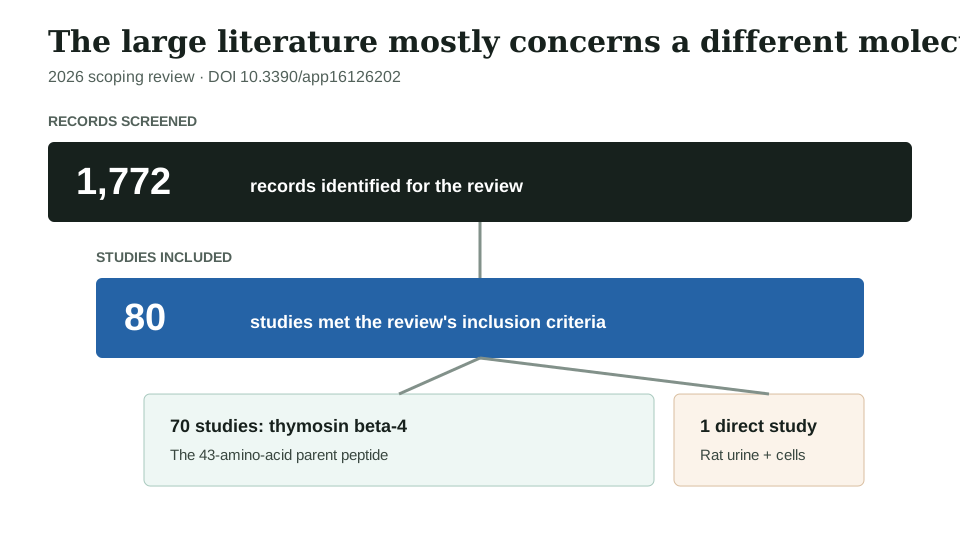
No published human study has measured a TB-500 benefit. A 2026 scoping review screened 1,772 records. It kept 80 studies. Seventy concerned thymosin beta-4. Exactly one tested TB-500 itself (DOI 10.3390/app16126202; checked 16 Aug 2026).
That one direct study measured metabolites in rat urine. It also tested fibroblasts in a dish. One metabolite showed more wound healing than the control. The paper states that the biological effects of TB-500 had not been documented (PMID 38382158; checked 16 Aug 2026).
The review found no direct human musculoskeletal intervention with administered TB-500 or thymosin beta-4. It reported that human evidence for the parent peptide was concentrated in eye, cornea, wound, skin and soft-tissue uses.
The review received no outside funds. It declared no conflicts of interest. It did not grade risk of bias because it was a scoping review.
CJC 1295/ipamorelin: what did human studies measure?
CJC-1295 and ipamorelin affect growth-hormone signalling by different mechanisms. No published controlled trial has tested the pair for muscle gain, injury healing or training recovery.
CJC-1295 raised growth hormone and IGF-I
Three published CJC-1295 studies involved people. All were published in 2006. Two were randomised, placebo-controlled, double-blind dose-escalation trials in healthy adults.
After one injection, mean growth-hormone levels rose twofold to tenfold for at least six days. Mean IGF-I rose 1.5-fold to threefold for nine to 11 days. The estimated half-life was 5.8 to 8.1 days (PMID 16352683; checked 16 Aug 2026).
The paper found no serious reactions. A 2026 peer-reviewed review found side effects in 94% of the treated group. The placebo figure was 29%. These rates came from one dose-escalation study. The review named injection-site reactions, headache, diarrhoea and systemic vasodilatory responses (PMID 41966639; checked 15 Aug 2026).
Those statements are compatible because a serious adverse event is a subset of all adverse events. The available record does not give the paper's funding statement.
The third study sampled blood overnight before and one week after CJC-1295. Growth-hormone output rose. Its pulse pattern remained. Basal growth hormone rose 7.5-fold (PMID 17018654; checked 16 Aug 2026).
A peer-reviewed review says a Phase 2 CJC-1295 trial was halted after a patient died. The review says the link to treatment was disputed. The registry marks NCT00267527 terminated. It gives no reason. ConjuChem sponsored the trial.
Ipamorelin released growth hormone but did not improve surgical recovery
A 1999 study gave one IV infusion to each of 40 healthy men. Ipamorelin caused growth-hormone release at every tested level. The peak occurred at 0.67 hours (PMID 10496658; checked 16 Aug 2026).
The study measured hormone levels rather than recovery, muscle or strength. The available record does not give the paper's funding statement.
A later Phase 2 trial enrolled 117 bowel-surgery patients. Its analysis included 114 people. The trial found no difference from placebo in its primary analysis. It also found no difference in the other efficacy tests (PMID 25331030; NCT00672074; checked 16 Aug 2026).
Treatment-emergent adverse events occurred in 87.5% of the ipamorelin group. The placebo figure was 94.8%. Helsinn Therapeutics sponsored the registered trial.
A second Phase 2 trial finished in 2014. It involved 320 people. NCT01280344 has no posted results. It has no linked results paper. Helsinn Therapeutics sponsored it. Its outcome remains unknown.
What people report in open forums
These accounts are self-reported and self-selected. The posters describe what they believe they used and felt. No outside lab checked their products. None of the quoted posters discloses payment for the post.
The quotations come from ExcelMale. Each link opens the complete thread. Excerpts are shortened only where marked.
A positive BPC-157 account about shoulder pain
thirdstone wrote in BPC 157 and/or TB500 (thread fetched with HTTP 200 on 19 August 2026):
I've had good results with BPC-157 for a tendon injury. A few years ago I had pain in my right shoulder that was getting worse and worse over 6 or so months. I went to an orthopedic doctor and he told me that it was the tendons in my rotator cuff.
He sent me to a physical therapist who prescribed the standard rotator cuff exercises. I lift weights regularly so those weren't doing much more. Then I tried BPC-157 and within about 3 weeks of starting it I was completely pain free.
A BPC-157 and TB-500 account with no discernible improvement
gaz7718 wrote in BPC 157 TB500 (thread fetched with HTTP 200 on 19 August 2026):
Over 4 weeks and no discernible improvement from the oral BPC 157 [...] but disappointed given some of what I had read in various places.
The marked span contains administration details and has been omitted.
A CJC-1295 and ipamorelin account
Mike Jason Pascual wrote in Began an experiment with Ipamorelin and CJC-1295 w/o dac (thread fetched with HTTP 200 on 19 August 2026):
So, far so good. [...] Workouts are excellent. Today is leg day so, I'll see how well I recover on Friday (2nd day after syndrome). I feel a little groggy in the morning.
The omitted sentence gives an administration amount and schedule.
These three posts do not establish a rate or a consensus. They show three individual reports: improvement, no discernible improvement, and a positive workout report accompanied by morning grogginess.
What independent vial tests found
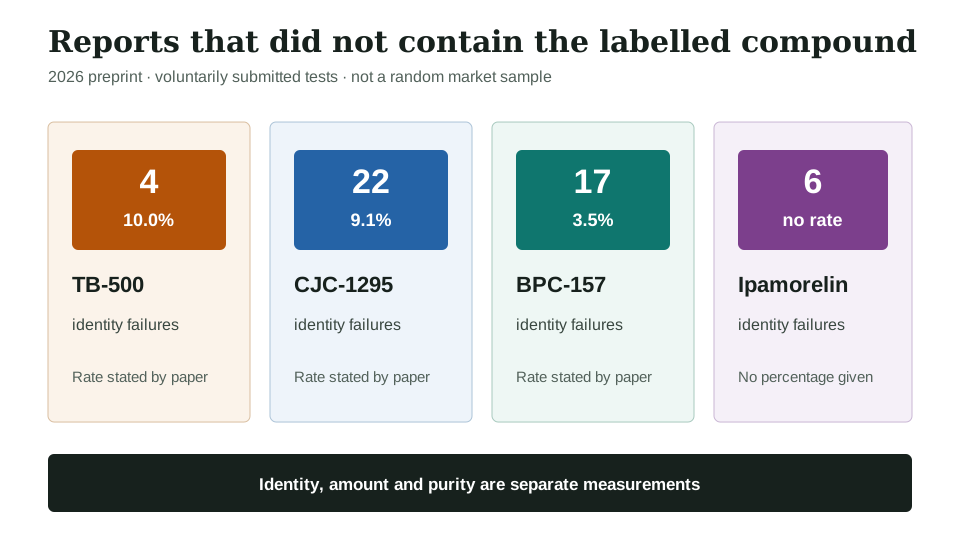
A 2026 preprint analysed 6,285 test reports. They came from a larger set of 6,487. People had sent them in by choice. The reports covered 14 peptides. The authors found 156 reports that did not contain the named peptide (DOI 10.20944/preprints202604.1748.v1; checked 17 Aug 2026). That was 2.4% of those screened (same DOI; checked 17 Aug 2026).
| Label | Reports that did not contain the labelled compound |
|---|---|
| TB-500 | 4 reports, or 10.0% |
| CJC-1295 | 22 reports, or 9.1% |
| BPC-157 | 17 reports, or 3.5% |
| Ipamorelin | 6 reports; the paper gives no percentage |
The overall median amount was 101.80% of the label claim. The overall median purity was 99.80%.
The reports were sent in by choice. They were not a random market sample. The study did not test sterility, residual solvents, particles, stability or structural integrity. The work had no outside funding. The authors declared no conflict of interest.
Other peer-reviewed papers show why a name on a vial needs its own check. A sample sold as CJC-1295 contained a different 29-amino-acid peptide (PMID 21204297; checked 16 Aug 2026).
Danish customs samples sold as ipamorelin and related secretagogues contained analogues with an extra glycine at the N-terminus (PMID 30136411; checked 16 Aug 2026).
Another paper found BPC-157 in confiscated vials. It did not report the vials' purity. It did not say how many were tested (PMID 28035768; checked 16 Aug 2026).
Questions about recovery peptides
Have BPC-157 and TB-500 been tested together?
No published controlled human trial of the combination was found by 19 August 2026. BPC-157 and TB-500 have separate evidence records.
Does BPC-157 have a human injury-recovery trial?
No completed controlled human injury-recovery result was found by 16 Aug 2026. A review of past knee cases found relief in seven of 12 patients. A randomised hamstring-strain trial is recruiting. It has no result (NCT07437547).
Is TB-500 the same as thymosin beta-4?
No. TB-500 is a seven-amino-acid fragment. Thymosin beta-4 is a 43-amino-acid parent peptide. Human studies of the parent do not establish what the fragment does.
Have CJC-1295 and ipamorelin been tested together for recovery?
No published controlled recovery trial of the pair was found. Separate studies show that each can change growth-hormone measurements. Those studies did not measure training recovery.
Does a vial label show that the product matches a study?
No. A label states what the supplier claims. The test data include vials with none of the named peptide. Other tests found altered analogues. A vial test and a clinical paper answer different questions.
Read the complete records
For vial, test and symptom questions shared across compounds, see the shared risk overview.
- BPC-157: every human report and open question
- TB-500: fragment identity, trials and literature count
- CJC-1295: hormone findings, adverse events and product identity
- Ipamorelin: two published studies and one unreported trial
- AOD-9604: the LAT8881 trial record
- What independent tests found in peptide vials
- The full compound register